Monday, 18 January 2021

Water and Society 2021 - Call for Papers

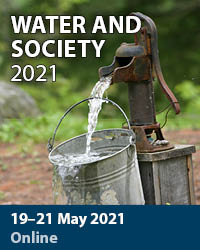
Water and Society 20216th International Conference on Water and Society

19–21 May 2021

Online


Introduction
The Water and Society Conference is to be reconvened in 2021 following the success of the previous meetings, the first of which was held in Las Vegas in 2011, followed by a meeting in 2013 in the New Forest, UK, home to the Wessex Institute; La Coruna, Spain (2015), Seville, Spain (2017) and Valencia, Spain (2019).

Over the centuries, civilisations have relied on the availability of clean and inexpensive water. This can no longer be taken for granted as the need for water continues to increase due to the pressure from a growing global population demanding higher living standards. Agriculture and industry, major users of water, are at the same time those that contribute to its contamination. Water distribution networks in urban areas, as well as soiled water collection systems, present serious problems in response to a growing population as well as the need to maintain ageing infrastructures.

Many technologically feasible solutions, such as desalination or pumping systems are energy demanding but, as costs rise, the techniques currently developed may need to be re-assessed. The Conference will address the interaction between water and energy systems.

This meeting will encourage trans-disciplinary communication on issues related to the nature of water, and its use and exploitation by society. The conference is motivated by the need to bridge the gap between the broad spectrum of social-political sciences and humanistic disciplines and specialists in physical sciences, biology, environmental sciences and health, among others.

The socio-political implications of a world short of clean, easily available water are enormous. It will lead to realignments in international politics and the emergence of new centres of power in the world.

Policymakers need to be educated and advised on developing policies and regulations that will support the water systems of tomorrow. The role of society and its involvement with water is paramount. To meet the future demands for water, new standards, new training and additional support roles will best be delivered by those knowledgeable of the new technologies and direction of the industry.

The intention of the Water and Society series of conferences is to review these issues, as well as the more technical aspects of water resources management and quality, to help put forward policies and legislation that will lead to improved solutions for all.

The papers selected for presentation and included in the Conference book are permanently stored in the WIT eLibrary where they are freely available to the international scientific community (https://www.witpress.com/elibrary).

Conference Topics

The following list covers some of the topics to be presented at Water and Society 2021. Papers on other subjects related to the objectives of the conference are also welcome.

  • Water resources management
  • Water as a human right
  • Water quality
  • Water resources contamination
  • Water, sanitation and health
  • Water and disaster management
  • Policy and legislation
  • Future water demands
  • Irrigation management
  • Water management
  • Urban water management
  • Management of catchments
  • Groundwater management and conservation
  • Agribusiness
  • Water science
  • Seawater desalination
  • Conservation strategies
  • Water and economy
  • Case studies

Thursday, 14 January 2021

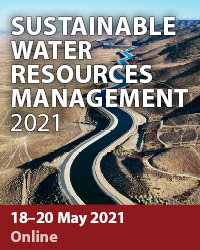
Sustainable Water Resources Management 2021 - Call for Papers

Sustainable Water Resources Management 2021

11th International Conference on Sustainable Water Resources Management: Effective Approaches for River Basins and Urban Catchments

18–20 May 2021

Online


Introduction
The 11th International Conference on Sustainable Water Resources Management will present recent technological and scientific developments, associated with the management of surface and sub-surface water resources and also the river basin management methodologies.

Water is essential for sustaining life on our planet and its uneven distribution is a source of permanent conflict. The growth of human population combined with the irregularity in precipitation and water availability may restrict even further the access to water in certain regions of the world. This problem is made more severe by anthropogenic activities that affect its quality.

River Basin Management includes all aspects of Hydrology, Ecology, Environmental Management, Flood Plains and Wetlands. Riverine systems are coming under increasing pressure due to anthropological and natural causes. Prominent amongst the problems affecting them is water scarcity and quality, which requires the development of improved methods for better river management.

Changes in the landscape, use of the land and climate conditions lead to a continuous re-evaluation of river basin management objectives. This requires the development of better measuring tools as well as the use of increasingly accurate computer software.

Catastrophic events such as floods and associated landslides, erosion and sedimentation can have serious effects not only on life and property but also on the basin ecology. Frequently these problems are aggravated by the unforeseen consequences of man-made changes in the river basin. This has led in recent years to work on river restoration and rehabilitation with various degrees of success.

The conference provides a platform for professionals involved in sustainable water resources management to exchange knowledge and gain an insight into the state of the art in the current technology, techniques and solutions in that field as they have been developed and applied in different countries. Participants include a wide variety of stakeholders from research and academia, to industrial sectors as well as government organisations.

The first conference of this series was held in Halkidiki, Greece in 2001, followed by Las Palmas, Gran Canaria (2003); the Algarve, Portugal (2005); Kos, Greece (2007); Malta (2009), Riverside; California (2011) the New Forest, UK, home of the Wessex Institute (2013); A Coruna, Spain (2015); Prague, Czech Republic (2017) and Alicante, Spain (2019).

Papers presented at the Sustainable Water Resources Management meetings are permanently available to the international community in digital format at www.witpress.com/elibrary.

Conference Topics

The following list covers some of the topics to be presented at Sustainable Water Resources Management 2021. Papers on other subjects related to the objectives of the conference are also welcome.

  • Water resources management and planning
  • Sustainable management
  • Ecological and environmental impact
  • Water rights and accessibility
  • Trans-boundary water management
  • Water markets economics and policies
  • Water resources in arid regions
  • Climate change effects
  • Flood risk management
  • Drought risk management
  • Rainwater management
  • Erosion and sediment transport
  • Irrigation
  • Groundwater
  • Wetlands as water sources
  • Estuaries and deltas
  • GIS and remote sensing
  • Integrated water analysis
  • Hydraulic structures
  • Hydropower issues and development
  • Hydrological modelling
  • Hydraulic modelling
  • Application of river hydraulic software
  • Data acquisition, management & analysis
  • Experimental measurements
  • Water quality and health
  • Agricultural pollutants and organic contaminants
  • River basin management
  • River restoration and rehabilitation
  • Water, food and energy
  • Water and the community
  • Case studies

Tuesday, 12 January 2021

BEM/MRM 43 - Post Conference Report

43rd International Conference on Boundary Elements and other Mesh Reduction Methods

7–9 December 2020
Online

Overview

BEM/MRM 43

With the main objective to preserve our delegates’ well-being, but also with the belief that the scientific community should not be stopped, WIT decided that BEM/MRM 43 should not take place as scheduled, in Florida, USA, but take place as an online event instead.

The conference was organised by the Wessex Institute (UK) and the University of Mississippi (USA), represented by Prof Alex Cheng, the Embry-Riddle Aeronautical University (USA), represented by Prof Eduardo Divo and the University of Central Florida (USA), represented by Prof Alain Kassab.

The conference, which started in 1978, is well-established and always attracts a wide international spread of delegates. The conference attracts high-quality papers that report further advances in techniques that reduce or eliminate the type of meshes associated with finite elements or finite differences, for instance.

Opening of the Conference

The conference was opened by Prof A. Cheng who welcomed the delegates to the event.

George Green medal

Following the opening of the conference, Prof A. Cheng conducted the George Green Medal Ceremony and awarded this year’s medal to Prof C.S. Chen, from the University of Southern Mississippi (USA). Subsequently, Professor Chen gave a keynote address on “Novel fictitious point methods using radial basis”.

Invited Presentations

There were a series of invited lectures on advanced topics of research and applications, as follows:

  • “An overview of method of fundamental solutions: Convergence and applications”
    Keynote address by A Cheng, University of Mississippi, USA

  • “BEM analysis of gravitational-capillarity waves on free surfaces of compound shells of revolution”
    by E A Strelnikova, Ukrainian Academy of Sciences, Ukraine

  • “Machine-precise evaluation of stress intensity factors with the consistent boundary element methods”
    by N A Dumont, Pontifical Catholic University of Rio de Janeiro, Brazil

  • “A new adjoint problem for two-dimensional Helmholtz equation to calculate topological derivatives of the objective functional having tangential derivative quantities”
    by T Matsumoto, Nagoya University, Japan

  • “Multi-physics coupling analysis of rope sealed structures with braided ceramic fibres by element differential method”
    by X W Gao, Dalian University of Technology, China

Conference Publication

Papers presented at this conference are published in the International Journal of Computational Methods and Experimental Methods (Electronic ISSN: 2046-0554). Papers presented at the meeting are available Open Access in the eLibrary of the Wessex Institute https://www.witpress.com/journals/cmem) from where they can be freely downloaded by any interested parties.

Related Conferences

CMEM 2021, 25–27 May 2021

BEM/MRM 44, 15–17 June 2021

AFM/MPF 2021, 6–8 July 2021

Materials Characterisation 2021, 7–9 July 2021

Friday, 13 November 2020

Water Pollution 2020 - Post Conference Report

15th International Conference on Monitoring, Modelling and Management of Water Pollution

30 September–2 October 2020
Online

Overview

Water Pollution 2020

With the main objective to preserve our delegates’ wellbeing, but also with the belief that the scientific community should not be stopped, WIT decided that Water Pollution 2020 should not take place as scheduled, in Valencia, Spain, but take place as an online event instead.

The conference was organised by the Wessex Institute, UK, represented by Professor Stefano Mambretti, Member of the WIT Board of Directors and the Polytechnic University of Valencia, Spain represented by Jose Sergio Palencia Jiménez (Chairman) and F. Jose Mora Mas (Honorary Chairman).

The meeting has been held in a variety of different locations every two years since it started in Southampton in 1991. The Conference provides a forum for discussion amongst scientists, managers and academics from different areas of water contamination. The wealth of information exchanged in this international meeting continues to be of great benefit to all involved with water pollution problems.

The environmental problems caused by the increase of pollutant loads discharged into natural water bodies require the formation of a framework for regulation and control. This framework needs to be based on scientific results that relate pollutant discharge with changes in water quality. The results of these studies allow the industry to apply more efficient methods of controlling and treating waste loads, and water authorities to enforce appropriate regulations regarding this matter. Environmental problems are essentially interdisciplinary. Engineers and scientists working in this field must be familiar with a wide range of issues and, in view of the scarcity of available data, it is important that experiences are shared on an international basis.

Opening of the Conference

The conference was opened with a presentation of the Wessex Institute followed by a welcome address by Conference Chairman Jose Sergio Palencia Jiménez, who explained the purpose and great benefits of this year’s online event.

Invited Speakers

There were a series of invited lectures on advanced topics of research and applications, as follows:

  • “Hydrochemical study in a portion of Paraiba do Sul River basin, Sao Jose dos Campos city, Sao Paulo State, Brazil”, by Daniel Bonotto, of São Paulo State University, Brazil
  • “20 years of progress: how the regional water resources program in the Pacific Northwest (USA) reduced water pollution”, by Robert Mahler, of the University of Idaho, USA
  • “Assessing climate change linkages related to water quality trading effectiveness for incorporating ancillary benefits”, by Michael Barber, of the University of Utah, USA
  • “Ecological and molecular approach to the assessment of oil pollution: a comparative study between two coastal marine (Mediterranean and Patagonian) ecoregions”, by Giuseppe Zappala, of the National Research Council, Italy
  • “Using dewatered sludge from drinking water treatment plant for phosphorus removal in constructed wetlands”, by Carmen Hernandez-Crespo, of the Polytechnic University of Valencia, Spain
  • “Nature-based water treatment solutions and their successful implementation in Kathmandu valley, Nepal”, by Zuzana Boukalova, of VODNI ZDROJE, a.s., Czech Republic
  • “Modeling of particulate matter fate on urban highway stormwater control systems”, by Mariana Marchioni, of the Polytechnic University of Milan, Italy
  • “Nine strategies to protect and enhance waterways”, by Glenn Browning, of Healthy Land and Water, Australia

Conference Sessions

The papers presented during the conference were classified under the following headings:

  • Water contamination
  • Assessing, monitoring, modelling and forecasting
  • Coastal and offshore pollution
  • Wastewater and water reuse
  • Sustainable urban drainage systems

Conference Publication

Papers presented at this conference are published in Vol. 242 of the WIT Transactions on Ecology and the Environment (ISSN 1743-3541). Papers presented at the meeting are available Open Access in the eLibrary of the Wessex Institute (https://www.witpress.com/elibrary) from where they can be freely downloaded by any interested parties.

A few papers were selected for publication in the International Journal of Environmental Impacts, and one for the International Journal of Computational Methods and Experimental Measurements.

Closing of the Conference

We are very sorry that we were not able to meet our delegates in person this year.

WIT is aware that one of the benefits of the conferences is the networking among colleagues and the only reason for implementing this strategy is the exceptional circumstances created by the covid-19 crisis. Thus, to allow the authors to maintain that capability, delegates who registered for this conference, and had their paper accepted for publication, are able to attend the next conference in the series (or a different conference of their choice devoted to similar topics that takes place prior to that) free of charge, and if they wish, make an oral presentation of their published paper.

We would like to thank the delegates for participating in the event and look forward to meeting them at the next conference in the series.

Related Conferences

Sustainable Water Resources Management 2021, 18–20 May 2021

Water and Society 2021, 19–21 May 2021

Sustainable City 2021, 5–7 October 2021

Thursday, 12 November 2020

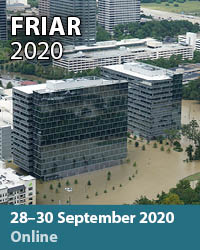
FRIAR 2020 - Post Conference Report

7th International Conference on Flood and Urban Water Management

28–30 September 2020
Online

Overview

FRIAR 2020

With the main objective to preserve our delegates’ wellbeing, but also with the belief that the scientific community should not be stopped, WIT decided that FRIAR 2020 should not take place as scheduled, in Valencia, Spain, but take place as an online event instead.

The conference was organised by the Wessex Institute, UK, and the Polytechnic University of Milan, Italy represented by Professor Stefano Mambretti, Member of the WIT Board of Directors and the Birmingham City University, represented by Professor David Proverbs.

The conference, which started in London, UK in 2008 is well-established and always attracts a wide international spread of delegates.

The 7th meeting took place at a time when the challenges of flooding are continuing to escalate across the world. For example, recent flooding across Africa affecting countries including Sudan, Senegal and Niger has caused hundreds of fatalities and impacted copious communities.

In the UK earlier this year and just prior to the COVID-19 period of lockdown, three storms predicated major flooding across England, Scotland and Wales.

Flood risk management research continues to advance our understanding, drawing on expertise from a wide range of disciplines.

The increase in global flooding is a consequence of a variety of complex and integrated factors, including climate change.

The series of conferences has demonstrated the widespread nature of flood hazards and has contributed to the evolving understanding of the science and policy contexts of flood risk management and has acknowledged that flooding remains the most damaging natural hazard globally.

Opening of the Conference

The conference was opened with a presentation of the Wessex Institute followed by a welcome address by Chairman Professor David Proverbs, who explained the purpose and great benefits of this year’s online event.

Invited Presentations

There were a series of invited lectures on advanced topics of research and applications, as follows:

  • “Pumped-hydro storage systems and flood risk mitigation: a proposed nexus”, by David Proverbs, of Birmingham City University, UK.
  • “The water nexus in Southwestern Idaho, USA: development versus agriculture”, by Robert Mahler, of the University of Idaho, USA.
  • “Flood environmental impact risk assessment”, by Martina Zelenakova, of the Technical University of Kosice, Slovakia
  • “Keeping everyone on the same page during flash flood emergencies”, by Baxter Vieux, of Vieux & Associates, Inc., USA
  • “Determining the impacts of wildfires on peak flood flows in high mountain watersheds”, by Michael Barber, of the University of Utah, USA
  • “Infiltration-exfiltration systems design under hydrological uncertainty”, by Gianfranco Becciu, of the Polytechnic University of Milan, Italy
  • “Using an ecosystems lens to explore a broader funding base for laneways”, by Jessica Lamond, of the University of the West of England, UK
  • “Performances and uncertainty of temperature methods for illicit infiltrations and inflows assessment in stormwater sewers”, by Mariana Marchioni, of the Polytechnic University of Milan, Italy.

Conference Sessions

The papers presented during the conference were classified under the following headings:

  • Flood risk management
  • Flood warning and forecasting
  • Flood modelling
  • Flood damage assessment
  • Blue-green infrastructure
  • Urban drainage systems

Conference Publication

Papers presented at this conference are published in Vol. 194 of the WIT Transactions on the Built Environment (ISSN 1743-3509). Papers presented at the meeting are available Open Access in the eLibrary of the Wessex Institute (https://www.witpress.com/elibrary) from where they can be freely downloaded by any interested parties.

A few papers were selected for publication in the International Journal of Environmental Impacts. This Journal covers the subjects on the numerous environmental problems present in modern society and their impacts, taking into account scientific, economic and social issues.

Closing of the Conference

We are very sorry that we were not able to meet our delegates in person this year.

WIT is aware that one of the benefits of the conferences is the networking among colleagues and the only reason for implementing this strategy is the exceptional circumstances created by the covid-19 crisis. Thus, to allow the authors to maintain that capability, delegates who registered for this conference, and had their paper accepted for publication, are able to attend the next conference in the series (or a different conference of their choice devoted to similar topics that takes place prior to that) free of charge, and if they wish, make an oral presentation of their published paper.

We would like to thank the delegates for participating in the event and look forward to meeting them at the next conference in the series.

Related Conferences

Sustainable Water Resources Management 2021, 18–20 May 2021

Water and Society 2021, 19–21 May 2021

Sustainable City 2021, 5–7 October 2021

Tuesday, 10 November 2020

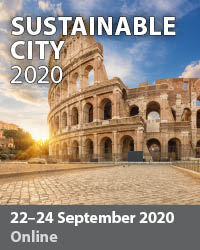
Sustainable City 2020 - Post Conference Report

14th International Conference on Urban Regeneration and Sustainability

22–24 September 2020
Online

Overview

Sustainable City 2020

With the main objective to preserve our delegates’ well-being, but also with the belief that the scientific community should not be stopped, WIT decided that Sustainable City 2020 should not take place as scheduled, in Rome, Italy, but take place as an online event instead.

The conference was organised by the Wessex Institute, UK, represented by Professor Giorgio Passerini, of the Marche Polytechnic University, Italy and Member of the WIT Board of Directors and by the University of Rome 'La Sapienza', Italy. Represented by Professor Stefano Ricci.

The conference, which started in Rio de Janeiro, Brazil in 2000, is well-established and always attracts a wide international spread of delegates.

The Sustainable City Conference addresses the multidisciplinary components of urban planning, the challenges presented by the increasing size of the cities, the number of resources required and the complexity of modern society.

Opening of the Conference

The conference was opened with a presentation of the Wessex Institute followed by an opening address by the Conference Chairman, Professor Stefano Ricci, to the Sustainable City Conference Series, welcoming delegates to this year’s online event.

Invited Presentations

There were a series of invited lectures on advanced topics of research and applications, as follows:

  • “Temporary transformations to access and experience sustainable city public spaces”, by Danila Longo, of the University of Bologna, Italy
  • “Methods to generate an expected turning traffic flow matrix for road junction analysis”, by Antonio Pratelli, of the University of Pisa, Italy
  • “The future of dwelling: rocking the house-boat”, by Camilo Cerro, of the American University of Sharjah, United Arab Emirates
  • “Urban tools and good practices: realizing sustainable public spaces”, by Marichela Sepe of the University of Naples, Italy
  • “Preservation of company towns in Mexico”, by Alejandro Acosta Collazo of Autonomous University of Aguascalientes, Mexico

Conference Sessions

The papers presented during the conference were classified under the following headings:

  • Urban strategies
  • The community and the city
  • Urban transportation and planning
  • Sustainable energy and the city
  • Architectural issues
  • Urban conservation and regeneration
  • Health issues
  • Intelligent environments
  • Planning for risk and natural hazards
  • Sustainable regeneration and liveable public spaces (Special session organised by Marichela Sepe)

Conference Publication

Papers presented at this conference are published in Vol. 249 of the WIT Transactions on Ecology and the Environment (ISSN 1743-3541). Papers presented at the meeting are available Open Access in the eLibrary of the Wessex Institute (https://www.witpress.com/elibrary) from where they can be freely downloaded by any interested parties.

A number of papers were selected for publication in several of the WIT Press titles, the International Journal of Transport Development and Integration, the International Journal of Energy Production and Management and the International Journal of Environmental Impacts. For further details on the titles mentioned, please see the WIT Press website: https://www.witpress.com/journals

Closing of the Conference

WIT is aware that one of the benefits of the conferences is the networking among colleagues and the only reason for implementing this strategy is the exceptional circumstances created by the COVID-19 crisis. Thus, to allow the authors to maintain that capability, delegates registered for this conference, and had their paper accepted for publication, are able to attend the next conference in the series (or a different conference of their choice devoted to similar topics that takes place prior to that) free of charge, and if they wish, make an oral presentation of their published paper.

We would like to thank the delegates for participating in the event and look forward to meeting them at the next conference in the series which is due to be reconvened in 2021.

Related Conferences

Urban and Maritime Transport 2021, 16–18 June 2021

Air Pollution 2021, 7–9 September 2021

Sustainable City 2021, 5–7 October 2021

Energy and Sustainability 2021, 6–8 October 2021

Wednesday, 4 November 2020

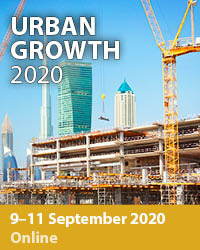
Urban Growth 2020 - Post Conference Report

2nd International Conference on Urban Growth and the Circular Economy

9–11 September 2020
Online

Overview

Urban Growth 2020

With the main objective to preserve our delegates’ wellbeing, but also with the belief that the scientific community should not be stopped, WIT decided that Urban Growth 2020 should not take place as scheduled, in Bilbao, Spain, but take place as an online event instead.

The conference was organised by the Wessex Institute, UK, represented by Dr Stavros Syngellakis, and the University of Siena, Italy.

The conference, which started in Alicante, Spain in 2018 is well-established and always attracts a wide international spread of delegates. The variety of topics covered by the conference reflects the quest for the sustainable city, that has until recently focused on the efficient use of resources with the application of technical advances giving rise to the definition of SMART Cities.

Opening of the Conference

The conference was opened by Professor Santiago Hernández who welcomed the delegates to the event.

Invited Presentations

There were a series of invited lectures on advanced topics of research and applications, as follows:

  • “Health and alternative tourism development for the island of Crete”, by Dr Dimitris Prokopiou, University of Piraeus, Greece.
  • “The Potential impact of information systems tackling the Sustainable Development Goal 10 on the dimensions of health care and gender” by Prof Roman Brandtweiner, Vienna University of Economics & Business, Austria.
  • “Cultural heritage and interoperable open platforms: strategies for knowledge, accessibility, enhancement and networking” by Prof Danila Longo, University of Bologna, Italy.

Conference Sessions

The papers presented during the conference were classified under the following headings:

  • Sustainable tourism
  • Sustainable Development conceptualizations
  • Water and flora management
  • Information technologies for sustainable development and planning
  • Sustainable energy, mobility and industry
  • City planning
  • Cultural heritage and quality of life
  • Climate change and rural areas development

Conference Publication

Papers presented at this conference are published in Vol. 241 of the WIT Transactions on Ecology and the Environment (ISSN 1743-3541). Papers presented at the meeting are available Open Access in the eLibrary of the Wessex Institute (https://www.witpress.com/elibrary) from where they can be freely downloaded by any interested parties.

A few papers were selected for publication in the International Journal of Energy Production and Management, International Journal of Transport Development and Integration and International Journal of Environmental Impacts.

Closing of the Conference

We are very sorry that we were not able to meet our delegates in person this year.

WIT is aware that one of the benefits of the conferences is the networking among colleagues and the only reason for implementing this strategy is the exceptional circumstances created by the covid-19 crisis. Thus, to allow the authors to maintain that capability, delegates registered at Urban Growth 2020 who had their paper accepted for publication, will be able to attend the next conference in the series (or a different conference of their choice devoted to similar topics that takes place prior to that) free of charge, and if they wish, make an oral presentation of their published paper.

Related Conferences

Water and Society 2021, 19–21 May 2021

Sustainable City 2021, 5–7 October 2021